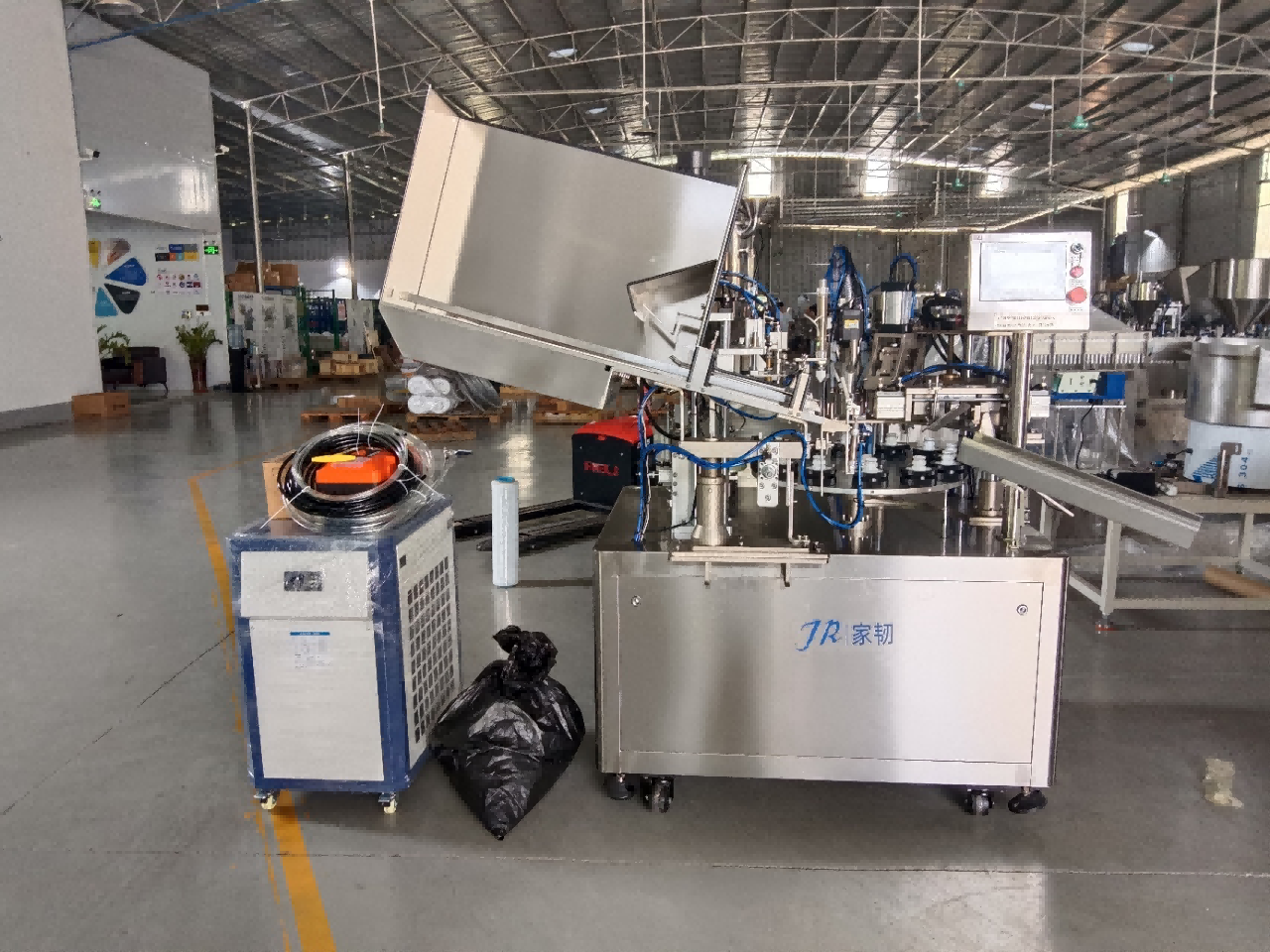
In the production site, the stable operation of the filling and sealing machine is directly related to production capacity and product quality. Many enterprises will encounter the problems of tail cracking and wrinkles when processing tubes with equipment. Although these seem to be minor faults, they may lead to the scrapping of batch products and affect delivery efficiency. Today, we will put these problems forward and disassemble the core reasons behind them one by one.
Question 1: The tube tail cracks frequently, and even gaps appear?
This is one of the most troublesome problems in many production links. The cracking position is mostly at the sealing interface, and sometimes accompanied by scorch marks. There are three main directions of core reasons:
1. Excessively high sealing temperature or uneven heating. The essence of tail sealing is to make the tube tail material reach a molten state through temperature and then shape it. Once the temperature exceeds the standard, the material will be overheated, the molecular structure will be destroyed, and it will be easy to be brittle and crack after cooling; if the heating component is aging or the distribution of the heating area is uneven, the local temperature is too high while other areas do not meet the standard, which will also lead to cracking——just like baking bread, the locally scorched part breaks when touched, and the undercooked part is sticky and soft and cannot be shaped.
2. Unreasonable setting of sealing pressure. If the pressure is too high, it will directly squeeze the softened tube tail material, leading to excessive stretching and cracking of the material; if the pressure is too low, it will not allow the material to fully fuse, the interface will not be firmly bonded, and it will be easy to crack during subsequent handling or use. Especially for tubes of different thicknesses and materials, the adaptability of pressure parameters is crucial, and it is impossible to use one set of parameters all the time.
3. The tube itself is not up to standard in material or size. If the tube raw material has insufficient toughness, too many impurities, or the wall thickness of the tube tail is uneven, the weak part will crack first under the heating and pressure of tail sealing. It's like folding things with poor-quality paper; the thin part is easy to tear.
Question 2: The tube tail has obvious wrinkles, affecting the appearance and sealing performance?
The wrinkle problem not only reduces the product's appearance but also may lead to poor sealing, resulting in subsequent problems such as liquid leakage and deterioration. The reasons behind it are also related to three dimensions: equipment, materials, and operations:
1. Insufficient precision or serious wear of the sealing mold. The mold is the core of tube tail shaping. If the mold surface is worn or deformed, or the size of the mold does not match the tube, the material cannot fit the mold evenly during shaping, and wrinkles will naturally appear; in addition, if the mold is not aligned with the center during installation, eccentric operation will also lead to uneven stress on the tail and form wrinkles.
2. Mismatch between equipment operation speed and sealing rhythm. If the filling speed is too fast while the sealing speed cannot keep up, the tube will slightly deviate or shake during transportation, and the material cannot be stably in place during sealing, resulting in wrinkles; on the contrary, if the sealing speed is too fast, the material will be quickly cooled before it can be fully shaped, and wrinkles due to uneven shrinkage will also appear.
3. Inadequate pretreatment of the tube tail or the influence of ambient humidity. If there is oil, water, or impurities on the tube tail before entering the sealing link, it will affect the melting and fusion of the material, leading to uneven wrinkles during shaping; in addition, if the humidity in the production environment is too high, the tube surface will absorb water vapor, which will also interfere with the sealing effect and produce wrinkles.
Question 3: Why do these problems sometimes only appear in specific batches of tubes?
This situation is mostly not a universal fault of the equipment, but caused by "material adaptation" or "batch differences". On the one hand, different batches of tubes may have slight differences in material composition, wall thickness, and hardness. These differences will be amplified under the fixed parameters of the equipment, and the originally adapted parameters will no longer be applicable to the new batch of tubes; on the other hand, if the supplier changes the tube raw materials or production process without timely synchronizing the information, it will also lead to cracking and wrinkles in the sealing link.
In fact, these faults of the filling and sealing machine are essentially the result of the mismatch between "equipment parameters, material characteristics, and operating specifications". The key to solving the problem is not to blindly adjust the equipment, but to find the contradiction first——if it is a problem of temperature and pressure, accurately calibrate the parameters; if it is a problem of the mold, timely repair and replace it; if it is a problem of materials, optimize the supply chain management and control.
Every small fault in production is an opportunity to improve efficiency. Only by solving these details well can the equipment truly exert its value and make the product quality more stable.


